October 25, 2009

Way To Be A Vegetarian For All The Wrong Reasons, Bagheera Kiplingi

bagheera kiplingi vegetarian

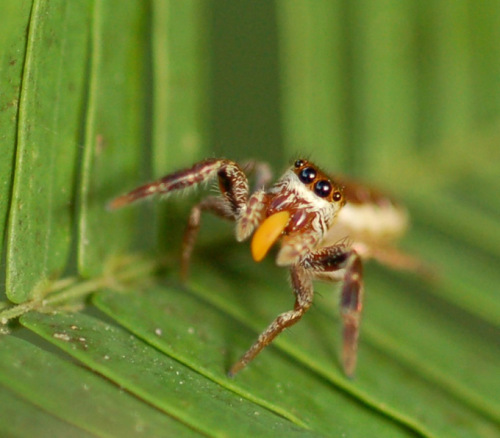
As published in the latest issue of Current Biology, researchers have identified the first-known mostly vegetarian spider out of the 40,000 discovered species in the world. The curious behaviour of this wide-eyed jumping spider, Bagheera kiplingi, discovered in the late 1800’s and named after Rudyard Kipling’s Jungle Book panther, has until recently remained a mystery. But by observing the neotropical species from south-eastern Mexico and north-western Costa Rica, the team discovered its preference for plant material over meat. Instead of digesting prey externally and consuming the liquified remains like most spiders would, the Bagheera kiplingi will eat whole plant material. However, it has also been observed to eat the occasional ant, spider, or ant larvae. Lead researcher, biologist Christopher Meehan from the University of Arizona, notes that the Bagheera kiplingi is “the first spider known to specifically ‘hunt’ plants. It is also the first known to go after plants as a primary food source.”

Taking advantage of the co-evolved mutualism between wasp-like Pseudomyrmex ants and the acacia shrubs they inhabit, the majority of the Bagheera kiplingi’s diet consists of the nutrient-enriched leaf tip structures of the plant (Beltian bodies), which ordinarily act as the ants’ reward for protecting it from predators. And just how the Bagheera kiplingi manages to snatch the harvest from right under the proverbial noses of these typically aggressive ants is really quite ingenious, as Meehan explains,

“Jumping spiders in general possess incredibly advanced sensory-cognitive skills and eight-legged agility, and Bagheera is no exception. Individuals employ diverse, situation-specific strategies to evade ants, and the ants simply cannot catch them.”

By building their nests in the oldest, most withered acacia leaves where the Pseudomyrmex ants are unlikely to patrol, the Bagheera kiplingi will use careful evasion tactics and its hydraulically-propelled jump to make its way to the Beltian bodies and back undetected. If spotted, it will use a line of silk to drop to safety. Meehan has also speculated that it might even be able to mimic the ants’ scent in order to mask its presence.

So I think I might know what’s going on here. Suddenly Bagheera kiplingi bursts onto the scene all like, “What? You guys, I’ve been a vegetarian for like, ever, and you’re only just noticing now? How self-involved are you?” even though you could have sworn that all spiders were predatory and need to eat things with faces in order to survive? I’m not buying it and I’m pretty sure I can spot a not-so-cunning ploy to impress that cute lady Pseudomyrmex ant who works at the book store across the road from your office when I see one. It was probably like, “Oh my god, Bagheera kiplingi, will you stop gazing wistfully out your window for once and fucking just ask her out? You’re starting to give me the creeps with that stuff.” So Bagheera kiplingi will reluctantly agree, you’ll pour him a stiff drink, and then tell him to go over and ask her for a Vonnegut and maybe a really expensive leather-bound journal or something because you have a lot of thoughts. The overwhelmed Bagheera kiplingi will ask, “Which Vonnegut?” and you’ll be like, “It doesn’t matter.”

“But she’ll think I’m some kind of hipster.”

“Probably. Hey since when is Bing our default now? What the fuck is that about?”

“What? Bing? Pretty sure we’re supposed to be talking about me here. Wait, did you just drink my scotch…?”

But against all odds, Bagheera kiplingi will somehow get the cute book store Pseudomyrmex ant to agree to go on a date with him, and he’ll return to the office with a large armful of books, and a slightly anxious look on his face. You’ll ask him what’s wrong and he’ll be like, “Well, she kept talking about her colony and how they do everything together and she’s like, ‘I suppose you’d try to eat everyone if you ever came over, yeah?’ So I told her I’m a vegetarian.”

“Dude.”

“I know. What else could I say? I panicked…”

So Bagheera kiplingi will take the cute book store Pseudomyrmex ant out to dinner, she’ll have the Beltian bodies and he’ll have, “I don’t know. A salad or something.” They’ll get terribly drunk and while waiting for a taxi outside the restaurant, Bagheera kiplingi will try his luck and ask if he can stay at hers. She’ll agree (don’t judge her - it was a lot of wine for such a little ant) and they’ll go back to her colony and, you know, mate and stuff.

“So what happened?” You’ll ask him, as he deletes the cute book store Pseudomyrmex ant’s number from his phone the next day over coffee.

“Well when I woke up I was surrounded by all these creepy fucking ants and I’m like, ‘Whoa, whoa, chill guys, I’m a vegetarian, I’m not here to eat you…’ But they all just start fucking laughing at me like, ‘Dude, do we look worried?’ and suddenly they’re on me like fully biting and stinging me and shit.”

“So what did you do?”

“What anyone would do: I shook them off, bounced over to the nest and stole a couple of larvae, then bounced the fuck out of there.”

“Shit. So I guess the whole vegetarian thing is over?”

“Nah, I think I might keep it up for a while. Those Beltian bodies are actually kind of delicious, plus it really pisses those Pseudomyrmex ants off when I steal their shit.”

“So you’re a vegetarian out of spite now.”

“Exactly.”

Current Biology // Not Exactly Rocket Science

- bec
October 7, 2009

Hey Polychaetes, Let’s Play the Silence Game Till the Next Whale-Fall, Okay?

In her recently-published dissertation for the University of Gothenburg, Swedish doctoral researcher, Helena Wiklund, identifies nine new species from two families of polychaete worms (Ophryotrocha and Vigtorniella) found on whale remains in Scandinavian and Californian waters. Polychaetes, a common type of marine annelid (or segmented worm), are found extensively across the ocean floor, and can be free-living grazers or attached to other organisms. All but one of the particular species Wiklund has concentrated on are free-living grazer worms who are adapted to the very specific habitat of a whale-fall, feeding off the bacteria that form filamentous mats over the surface of decomposing whale bones.

When whales die and sink to the ocean floor they provide a vast amount of food for a variety of marine life. The decomposition of a whale carcass takes place over three stages which involve specific types of organisms attending to different parts of the carcass. The initial stage of decomposition involves the larger flesh-eating organisms such as hagfish, sleeper sharks, and crustaceans, who pick the decaying flesh away from the skeleton. The second stage involves great numbers of macrofauna, like these newly-discovered and highly-specialised species of 2-centimetre-long polychaetes, gathering in the sediment that falls on and covers the bones, and the final stage sees the polychaetes feeding off the bacterial mats that form across the surface of the bones.

What Wiklund has also discovered is these species of bacterial mat-dependant polychaetes can also survive on sunken wood and beneath man-made fish farms, both the kinds of environments where concentrated amounts of nutrient-rich sediments can settle into these bacterial mats.

While whale-falls can feed many generations of polychaetes over several decades, they are few and far between, and just how the worms are able to travel from one carcass to another has posed a bit of a challenge to Wiklund. The Ophryotrocha larvae develop very quickly, the juveniles reaching adult form within days of hatching, making long-distance dispersal unlikely, as they can’t spend months traveling on ocean currents to the next whale-fall without the proper nutrients. However the Vigtorniella species have long-living larvae which can take up to nine months to reach adult form, and thus long-distance dispersal is a possibility.

Now I can totally hear a bunch of migratory birds being like, “So the Vigtorniella larvae travel long distances. Whatever! We do that all the time, but are people always discussing how awesome that is? No!” And of course, they’re right, but we do have to be mindful of the fact that these are kids - or larvae, if you prefer - who are traveling long distances together, and that they make it to the next whale carcass at all makes it absolutely worth mentioning. I’m not suggesting that things are likely to decline into a sort of Lord of the Flies-like bloodbath, but it’s not like there are any adults around to be like, “Stop hitting your sister!” and “Didn’t I tell you to go before we left? We’re not stopping for another half an hour, so you’re just going to have to hold it in!”

Like, the journey would probably start out okay, the larvae all excited about finding a new stash of delicious whale bones to supply them with a multitude of breakfasts, lunches, and dinners, and for a while barely a word would be exchanged between any of them because they’re all too busy playing Petz or Lego Batman or something on their DS. But whale-falls are pretty rare and while the DS battery life is alright, it certainly isn’t going to last an entire trip, and you just know that someone will have forgotten to recharge theirs the night before. So one of the larvae will suddenly be like, “UGH!” pointedly slamming her DS shut so that everyone close by will hear her, and she’ll find one of her sisters and be all, “Hey, so my DS just died. Can I have a go of yours quickly?”

And her sister will be like, “Umm no way. I don’t want you using up all my battery life too.”

“But mum said we have to share!”

“Mum said to charge yours before we left.”

“I HATE you!”

“I hated you FIRST!”

And that’s just on the first day. Pretty soon it will degenerate into something along the lines of:

“I’m BORED. My pygidium hurts, and I need to go to the bathroom REAL BAD.”

“OH MY GOD… now I have to go!

“Ugh. Prudence, will you please tell Alex that it’s not my fault that she needs to pee and maybe she should stop trying to copy everything I do, and yes I’m still not talking to her because of that thing she said about how I always snort when I laugh which is so. not. true, because I know what I sound like and I don’t sound like someone who snorts when they laugh.”

“FINE. Umm Prudence, can you please tell Jessica that I said, “No offense,” before I said the thing about snorting, and Jessica said, “Okay.” So it’s not my fault she got offended when she already promised she wouldn’t get offended before I even said it.”

“Prudence, will you please tell Alex that just because she said, “No offense,” it doesn’t mean she can just say whatever she wants, like, I bet she wouldn’t like it if I said, “Hey, Jessica, no offense, but your chaetae are looking pretty thin. Maybe it’s because you’re underdeveloped…?” would she?”

“Prudence, will you please tell Jessica that actually I am allowed to be offended by that because I didn’t actually say, “Okay,” to the “No offense,” and- Wait, what do you mean my chaetae are thin? As if they are and at least my bristles aren’t too short like yours are!”

And somehow they manage to ride the ocean currents across extensive distances without pulling each other’s segments apart. I know I’m impressed.

Original Dissertion (open access) // Paper in Zoological Journal of the Linnean Society // Pictures courtesy of Helena Wiklund.

- bec

October 3, 2009

You Guys, You’re Going To Give Hydrolagus melanophasma A Complex!

So you’ve probably already heard about it a billion times over, but yes, a team of researchers from the Pacific Shark Research Center and the California Academy of Sciences have identified a new ghost shark, publishing their findings in the September issue of Zootaxa. Named Hydrolagus melanophasma, (Hydrolagus the Latin term for ‘water rabbit’ and melanophasma the Latin term for ‘black ghost’) this Eastern Pacific black ghost shark had actually already been discovered as far back as 1947, as the preserved specimens kept at the Scripps Oceanographic Institute would indicate, but it wasn’t until a live individual was filmed off the coast of Southern California using the Monterey Bay Aquarium Research Institute ROV and compared to the museum specimens that the researchers realised the species had never been formerly identified.

This ghost shark, (which is actually not a shark but a cartilaginous type of fish called a chimaera, that as a group branched off from the shark lineage around 400 million years ago) has been generating a lot of attention because of its unique appearance and curious appendages. As is characteristic to male chimaeras, the large, blackish-purple Hydrolagus melanophasma has what scientists speculate are specific types of sex organs, or ‘tenacula,’ sprouting from its forehead, near its pelvis, and in front of its pelvic fins, which essentially look like little clubs covered with spikes. But while it has been suggested that these organs are used by the chimaera to assist with mating, their function is actually quite different from that of the penis, in that they are probably used by the male to grip on to the female, the pelvic tenacula acting as a funnel for the sperm as it is transferred to the female.

So of course while this whole “sex organ in the face” thing is pretty fascinating, I’m not so sure it’s particularly appropriate or sensitive to the Hydrolagus melanophasma’s feelings to be calling it “freaky” and “bizarre” all the time and making jokes of a sexual nature at his expense, especially since we’ve really only just met. And besides, I’m willing to bet that the Hydrolagus melanophasma has already had his fair share of ridicule, having grown up around a whole lot of sea creatures who don’t have sex organs in their faces, because, you know, kids can be pretty cruel about that kind of stuff.

It probably started with a young Hydrolagus melanophasma having an awesome time playing Brandings or something in front of the spiny dogfish’s cave with a bunch of other primary school sea creatures. Then just when the umbrella crab is about to peg a rather large anemone kinda hard at him, the Hydrolagus melanophasma’s sex organ will accidentally start clasping idly at nothing in particular and the umbrella crab will be all, “Eww! Hydrolagus melanophasma has aliens coming out of his face! RUN!!” And poor Hydrolagus melanophasma will be super-embarrassed and confused, and will try hiding with a couple of wolf eels behind a sunken oil drum before getting squealed at and shoved away, because of his “gross alien germs,” and such.

So the Hydrolagus melanophasma will go home to ask his parents if he really does have aliens coming out of his face, and Mum and Dad Hydrolagus melanophasma will briefly whisper something to each other, coming to the conclusion that he’s probably old enough to have “The Talk.” So they’ll sit him down after dinner, mention something about genitals and love, and then inexplicably start blowing whatever the fish version of a condom is up like a balloon. The young Hydrolagus melanophasma will ask what that was supposed to teach him about responsible reproduction, but his dad will tell him not to be smart and The Talk’s over so go watch some cartoons or something.

But soon enough the kids at school will also work out what his face aliens actually are, and this will unfortunately coincide with the exact moment that they discover the joy of the “comeback phrase.” The Hydrolagus melanophasma would be in the canteen line quietly discussing an upcoming chemistry exam with one of the sleeper sharks in his class, and how that video of atoms making out on the dance floor at a disco probably wasn’t as much help as it should have been because instead of learning anything important he spent the whole time wondering how the cartoon was going to successfully carry the metaphor all the way to covalent bonding if the atoms didn’t actually have any genitals, when a heckler from the hungry throng will be all, “Your FACE is a genital!!” And much to the Hydrolagus melanophasma’s mortification, the rest of the sea creatures in the queue will burst into fits of cruel laughter and somebody else will add, “That’s what she said!!” and “I’ll show YOU my genitals!!”

And the Hydrolagus melanophasma will be all, “Whatever, dickheads,” but this will only make the raucous a billion times worse as everyone struggles for enough breath to be the first to manage a spirited, “I know you are, but what am I?!”

The increasingly upset and frustrated Hydrolagus melanophasma will at this stage probably lose it, and start informing everyone that it’s not even a penis, it’s just a clasper, but he won’t make it much further than that before someone cuts in with another, “That’s what she said!!”

And the first thing we all do when we find him is call him a freak. Nice one, guys. Way to make a positive first impression. Jesus.

Neurotopia // Original paper (by subscription)

- bec

September 21, 2009

Beware Those Yellow Crazy Ants, Christmas Island White-Eye…

An online report published in last week’s Biology Letters has revealed the damaging effect an invasion of ants (Anoplolepis gracilipes) is having on some of Christmas Island’s native bird and plant species. In this study, led by ecologist, Dennis O’Dowd of Monash University in Melbourne, experiments were carried out to see if the ants’ behaviour inhibited small forrest passerines such as the Christmas Island White-eye and the Island Thrush from eating the produce of the local fleshy-fruited plants.

By setting up equal numbers of model fruit displays and real fruits in areas both cleared of and occupied by the supercolonies of Anoplolepis gracilipes, commonly known as ‘yellow crazy ants’ on account of their erratic reaction when disturbed, the team was able to observe the instances of fruit-handling by the two species of birds in both kinds of environments. Using peck-marks on the 1151 model fruits that were handled by the birds, they found that both the white-eye and the thrush were less likely to approach the fruits in areas inhabited by the yellow crazy ants, with the handling rates up to 2.4 times lower in the ant-invaded areas than those which were ant-free.

As the consumption and handling of fruit is imperative to the reproduction of both the local plants and native birds, a reduction in fruit-handling due to the steadily expanding supercolonies of yellow crazy ants is a conservational concern, especially given that the numbers of Christmas Island red crabs have already been greatly affected by this ant invasion. As O’Dowd observed, the yellow crazy ants would often climb onto the birds, causing them to ruffle their feathers and stomp their feet in an attempt to shake them off, this behaviour proven to be far more deadly where the red crab is concerned, the ants known to swarm over the crabs, spray them with formic acid, and bite them to death.

Figure 1*

So I can kind of see where the white-eyes and red crabs are coming from. It’s not like either of them are known for being particularly short-tempered creatures, so if they say the yellow crazy ants - or YELLOW KRAZEE ANTZ, as they prefer to be called - are insufferable, I’m willing to bet they are. Like, a Christmas Island White-eye will be quietly wafting through the forrest one day, feeling kinda hungry, before stumbling on a cluster of plump reddish berries. He’ll skip around them for a bit, sizing them up and being like, “Hey, berries, awesome.” But that brief moment will probably be ruined by a bunch of YELLOW KRAZEE ANTZ who will come marching over all like, “OH HAI! OMG you guys, I can’t believe we ate an entire pie for BREAKFAST!!!!!1!!!” and the Christmas Island White-eye will roll his eyes, all sarcastic, like, “Oh okay… CRAZY…! Now listen, ants. I’m pretty hungry, and I just found these berries, so would you… umm, hey excuse me, you’re kind of in my way, I was just going to peck there and erm…”

But the ants will all ignore him with their, “Aw shit, I think I just sent a NSFW gif to everyone in the ENTIRE COLONY, LOL!!!!!!1!”

“ROFLCOPTER!!!!!1!!”

“OMG I totally almost opened that in front of the QUEEN!!! LOLOLOL!!!!!1!!”

At which point the poor Christmas Island White-eye will crossly cut them off with a, “SHUT UP! Just shut up! No one cares! I just want to eat the… Jesus Christ, get the hell off me, you shits!! OFF! Okay fine. You know what? I’m done. You can have the berries. Have ALL the berries you want, I’m getting the fuck out.” And with that, he’ll shake the remaining YELLOW KRAZEE ANTZ out of his feathers and fly off, hungry and pissed.

Then the Christmas Island White-eye will run into a group of red crabs making their annual migration from the forrest to the shore, and one of them will call out to him like, “Hey, Mister White-eye! How’s the family?” And Christmas Island White-eye will tell him about how one of his chicks, Jessica, is hell-bent on leaving the nest before her wings are ready, and Red Crab will sigh good-naturedly and declare, “Fledglings,” at which Christmas Island white-eye will nod with a, “Bless ‘em. So how’s the migration going?”

But before Red Crab even has a chance to respond, an army of YELLOW KRAZEE ANTZ will turn up and start crawling up on top of the both of them, all like, “Oh HAI guys! Guess what??!! We accidentally slept in this morning, so we’re doing an expedition… in our PYJAMAS!!!!!!1!!! LOL!” And Christmas Island White-eye will be like, “Well I know where this is going…”, and shake a handful of those tiny yellow menaces out of his feathers before getting the hell out of there. But Red Crab will hesitate nervously, and as a trail of YELLOW KRAZEE ANTZ parade across his claws, he’ll be like, “Umm look. I’m just trying to migrate to the shore over there with a few hundred of my relatives, and we’d really appreciate it if you’d just leave us alone, okay?”

But the YELLOW KRAZEE ANTZ are having none of it, being like, “Whatever man, we’re going to eat your insides!!”

“ROFLCOPTER!!!!!1!”

“Haha! ACID IN THE FACE!! AIM HIGHER, HIS EYES ARE ON STALKS!!!”

And having finally dismantled said crabby insides, this supercolony of arseholes will take all the pieces back to their nest for lunch, after which they’ll probably build something not unlike THIS.

Biology Letters report // Science News.org

* Figure 1 from original paper. (a) Artificial fruiting display with model fruits, (b) red model fruits (scale bar, 1 mm) handled by the thrush ((c) left fruit; credit: Kee Seng Foo) or white-eye ((d) right fruit; credit: Tony Patisser).

- bec

September 19, 2009

It Pays To Be Nice To Your Tongue-Eating Isopod, Unfortunate Weaverfish.

The rare Tongue-eating louse (Cymothoa exigua) has been found inside a weaverfish by fishermen off the coast of the Minquiers, a small group of islands under the jurisdiction of Jersey. Although called a louse, it is actually a 2cm-long parasitic isopod crustacean, and it survives by burrowing into a fish through its gills, attaching itself to the muscular base of the tongue, and sucking the blood from it until it eventually withers away to nothing. The isopod then behaves almost like a replacement tongue, causing no additional harm to the host fish as it feeds off the scraps of food that enter its mouth.

Now Weaverfish, this situation can go either way, depending on how well you treat your new, umm, guest, and if you want my opinion, you should probably try to make the most of things because that isopod isn’t going anywhere in a hurry. But, you know, it’s your isopod, and you’ve got to make up your own mind, so here’s where I can see it going.

If you do decide to be civil to your new isopod, making him feel welcome and almost like a friend, (as opposed to a horrifying parasitic nightmare who just devoured one of your very important organs) I’m sure he’d be more than happy to pay a little for his keep. Like, you know that cute lady weaverfish you like but are too shy to talk to, so you always end up having a conversation with whomever is sitting next to you at the time and, oh shit, it’s that dude who responds to everything you say with a, “Haha! Weaverfish, you’re great. I’m buying you a drink… JK! Haha! Seriously though, I’m too poor,” which in turn reduces you to guiltily tweeting about how mediocre the mysis shrimp tastes while the cute lady weaverfish regales everyone with her hilariously cringe-worthy stories about being brought up by two really sexually-liberated parents? Well, your isopod will probably think she’s kinda gross because he’s not that into girls, he’s more into very important organs, so you guys could totally do the old, “Oh here’s a neat idea - why don’t you tell me what to say to the boy/girl I like because you’re so eloquent and/or suave and I’m so stupid and/or shy and she/he will totally fall in love with me because they’ll think I’m eloquent and/or suave too?” shtick. And it’ll be so much easier than when most awkward lovers try it because, for obvious reasons, your isopod won’t have to submerge himself in a clump of seaweed nearby to hide from the cute lady weaverfish’s view. And being internal, you’re unlikely to have one of those disastrous, “Lady weaverfish, being with you is like….eternal parasite? Hey fuck you, Isopod, do it properly! Jerk. What? Oh. Umm… Being with you is like eternal paradi… Oh she’s gone. Shit,” moments.

And your isopod would also be a great asset for when you play trivia, because I bet you could easily fit a tiny set of encyclopedias in there with him (no, Weaverfish, there aren’t any waterproof smart phones yet, I’ve checked) and maybe even a very tiny atlas as well. You’d never get bored because everyone will think you’re a total genius and you won’t even have to do that thing where you screw your own team over by making up ridiculous answers and convincing them they’re the right ones, purely for the LOLs.*

On the other hand, you could be a right shit about the situation and every time you run into someone and they ask you how you are, you roll your eyes all like, “Well I would be fantastic if it wasn’t for this fucking isopod who sucked my tongue dry and permanently latched himself onto the stumpy remains with his razor-sharp claws.” Isopods have feelings too, Weaverfish. He’ll just get pissed off and upset and before you know it, you’ll be quietly swimming past a bunch of jellyfish, minding your own business, when all of a sudden your isopod calls out through your gills, “Hey, arseholes! Take your incomplete digestive systems elsewhere! Seriously, no one needs to see you take a shit out of your face. NO ONE!” After which one of them will come over, give you both the literal and figurative version of a shit-eating grin, and ask you if you know what it feels like to be gang-raped by a bunch of jellies. Quick as a flash your isopod will tell them you don’t, but you bet they fuck like a bunch of really bored women and you’ll barely feel a thing. Suddenly you’ll be surrounded by fifty-odd jellyfish wearing those shit-eating grins and, well, Weaverfish, we should probably leave it there.

Then later you’ll be swimming along, once again minding your own business, and you’ll pass a long-finned pilot whale who’s having a particularly bad day. Before you can even attempt to cover your gills up with your tiny fins, your isopod will be like, “Hey, long-finned pilot whale! You’re the worst dolphin ever. Just because you act like a whale and people call you a whale, doesn’t mean you’ve finally found your place in the world. What a fucking phony. Get out of my ocean!” And yes, your isopod does have a death wish because that long-finned pilot whale might act a lot like a whale, but he certainly doesn’t eat like one. Plankton and krill won’t save you this time, foolish Weaverfish!

So yes, this situation is really not ideal for anyone (except maybe your isopod, who gets free food, accomodation and transport), but there’s no excuse for being a whiny little bitch that no one wants to play with. Your isopod is not unlike a government-supported gypsy and it’s like I always say: Cross a gypsy, and you’ve got no one but yourself to blame when they throw babies at you while they steal your wallet.

* Plus they’ll probably stop inviting you if you do this too many times, Weaverfish. Believe me, I know.

BBC original report.

- bec

September 10, 2009

Those Great Tits Want Your Braaaains, Pipistrelle Bats.

great tit

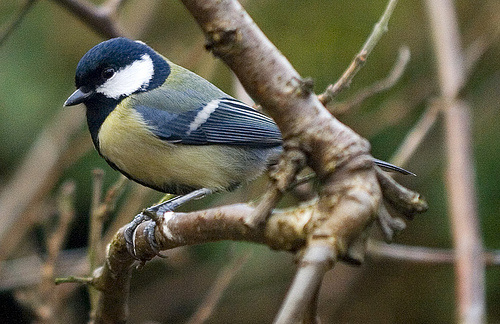
As delicately pretty as it might look, the great tit (Parus major) has been gaining quite the reputation for being involved in some seriously gruesome behaviour. Driven by hunger when their normal diet of insects has grown scarce, the great tit has been known to peck open the skulls of other passerines, or “perching birds,” and also tiny pipistrelle bats, the occurrence of the latter described in a paper published yesterday in Biology Letters. Péter Estók and Björn Siemers, bat ecologists of the Max-Planck-Institute for Ornithology, Germany, studied a group of fifty-odd great tits over two winters, observing eighteen cases of pipistrelle hunting in a particular Hungarian cave in the Bükk Mountains.

Having seen a single great tit hunt a pipistrelle during the winter of 1996 in the same cave, Estók set out ten years later to determine whether or not this was just a one-off case. What they believe to have found, however, is an example of cultural transmission, as in a specific behaviour learned from other individuals and passed on through generations, as tits very rarely manage to live older than eight years old. Using the waking call of the pipistrelles as they come out of hibernation, these diminutive five-inch long predators track the groggy bats down, wrench them from their hidden roosts in the cave walls, and crack open their skulls to consume the brain within.

As part of their research, Estók et al. played a recording of the waking bat calls to the group of great tits, finding that the noise attracted around 80% of the tits, who responded by drawing closer to the speakers. This result is contrary to what has been observed in previous studies of bat calls, which have successfully served as deterrents to potential predators, the chatter effectively driving them away. The researchers also provided the great tits with bits of bacon and seeds to determine whether the attacks on the pipistrelles were the result of the birds having developed a taste for bat brain, or of a paucity of more desirable food alternatives. They found the tits to prefer the food that was provided for them, observing only one case of pipistrelle predation at this time, suggesting that this perculiar behaviour is motivated by necessity.

Okay, yes, Pipistrelle Bat, this situation is all very gross and dire for you. No one is particularly happy about having to wake up from an enormous sleep, especially when there’s a chance they’re going to have their brain case pecked open when they do so. But it doesn’t have to be this way. You need to fight back, and playing to your strengths is probably the key to your success in this situation.

But what are your strengths, tiny Pipistrelle, I hear you ask? Well, being bats, preferring to hang out in dark caves as you do, tightly hugging yourselves with those membranous black wings as you grip inside leaky crevices with those dirty, possibly frayed claws of yours, you’ve been described on more than one occasion as being “creepy.” But don’t be offended, Pipistrelle Bat, I’d still invite you for tea at my house, so long as you promised to keep the chatter to a minimum, but more to the point - your creepiness could be your best asset in driving away those great tits. They’re hardly going to want to eat something they’re revolted by, right? So next time you stir from hibernation and start talking to the bat next to you, only to have a hungry great tit fly right over and give you the murderous side-eye (because being bird, that’s all they’ve got, tiny Pipistrelle), say something to the bat next to you like, “So when I was little, my mum used to nuzzle my neck before bed and it kind of gave me shivers, like, good shivers. You know the ones I mean, right? Is that weird?” and the great tit would be like, “Eww, you’re secretly attracted to your mum? Gross!” and fly away in disgust.

This tactic will serve you well, Pipistrelle Bat, I’m quite sure, however it’s only a matter of seasons before the great tits will talk amongst themselves and work out what you’re doing. They’ll be all, “Okay, this winter, there is no way we’re going to get psyched out any goddamn inch-long bats.” So you’ll have to up the ante a bit to combat their determination. You might want to call upon such classics as, “Oh hey, great tit. My, those are some nice legs. They’re so… skinny. Almost like the legs of a child. Oh, what I would do with them…” or, “You know, when I hear the Pipistrelle opposite me having their brain case pecked open and he’s shrieking and all like, “Oh for the love of God, just kill me!” I get kinda hungry. What’s that about?” and the great tit staring you down will be like, “Dude, I’d rather starve a thousand times over than consume your fucked up brain matter. I’m going home to my family so I can make love to my wife.

So as long as you’re okay with having the reputation of being some kind of deviant who’s attracted to their mum/minors/their friends dying a painful drawn-out death, you should be safe from the murderous beaks of those deceptively adorable yellow birds. Just remember, a good reputation is nothing if you’re without a head, tiny Pipistrelle Bat.

New Scientist // Not Exactly Rocket Science // Tetrapod Zoology

- bec